Tuesday, May 27, 2014

FRESH TAKE: The Amazing Spider-man 2

AS ALWAYS WITH FRESH TAKES:


SPOILERS ARE PRESENT!


I have to admit, these new Spider-man movies don't really appeal to me. It might seem strange, given that they've finally made Spider-man funny and Peter Parker is the Marvel hipster right now, but they just don't do it for me. They've managed to mix one of my favorite Spidey stories (that of the early days with Gwen Stacey) with one of my most hated Spidey stories (that of his parents and this "everything is connected" conspiracy). The first Amazing Spider-man was ok, but I didn't really feel the need to rush out and see that. Same was true here.

Going into it, the previews made it appears as though it would suffer the same fate as Spider-man 3 in that they would try to cram so much stuff into a two hour movie that it would chop up the flow of the story to the point where the story becomes incredibly weak. The trailer includes footage of Electro and Rhino and implies Harry Osborn would take up the glider - either in this film or in the next one. Word then started streaming in that Rhino was only in the movie for about five minutes. So then it seemed like it would be ok: Rhino would just be an intro villain to re-establish Spider-man. Electro would be the main villain.  And in the background, they would likely build Harry as the main antagonist of the next film.

Well, the good news is that they didn't try to cram so much stuff into a two hour movie. The bad news is, they did try to cram too much stuff into a two and a half hour movie. It drags in almost every way imaginable. The Amazing Spider-man 2 is a great example of how the building of an arc comes at the detriment of the individual films. Here, the basic story of Electro vs. Spider-man and Peter Parker's creepy stalking of Gwen often gets chopped up by flashbacks of Peter's parents and back story that literally has no bearing on this particular film. Then we also get these stories broken up by the sudden inclusion of Harry Osborn and his sick not-Green Goblin father (who looks like a green goblin, but isn't the Green Goblin). It's not to say that the Osborn drama isn't interesting, but it's completely unnecessary to the basic overall plot. As such, it feels crammed in there. Even worse, it's not enough that the Harry/Norman and Harry/Peter story is jammed in there; they also have to then connect the Norman Osborn thing in with Peter's parents. So once again, this film's plot gets broken up by an overarching plot that has no bearing to this film.

One of the improvements of the Amazing Spider-man series from the Sam Raimi films is that Spider-man behaves a lot more like the character from the comics. We get to see Spider-man making quips and being funny. Amazing Spider-man 2 does an even better job than the first one at making him legitimately funny. There are several moments that feel straight up from a comic - the best being Spider-man putting Electro out with a fire hose while wearing a firefighter helmet. At the same time though, they made Peter Parker less Peter Parker-like. (It's almost like directors and writers have no idea how to do Peter and Spider-man!) Apart from being the resident hipster of the Marvel movies, this Peter Parker is confident and cocky. He's self-assured, despite all of the guilt he harbors toward the death of Captain Stacey and subsequently the danger he puts everyone he loves in.

In Raimi's films, Peter overdoes it with the guilt and is often far too serious. As a result, Spider-man isn't funny. Instead, he spends most of the film screaming as he desperately tries to save Mary-Jane. In Marc Webb does the opposite. Spider-man is extremely confident and funny, but that's because Peter is confident and funny. It's almost as if they've never bothered to actually read Spider-man comics. It makes sense that there would be crossover personality between Spider-man and Peter Parker, but what makes Spider-man more interesting than your Iron Man and Captain America fare is that the character isn't the same in the suit as he is out of it. When he's Peter Parker, he's supposed to be this nerdy, kind of shy person. He's representative of the "little guy." But when he puts on the Spider-man suit, he's suddenly confident and heroic. It's a great representation of what everyone has inside of themselves, even the wallflowers! In many ways, Webb's Spider-man films serve to undermine the interesting element of Spider-man as a character. In this way, the very first Spider-man actually gets closest to the character of the comics.

It also seems only fitting that The Amazing Spider-man 2 shows up shortly before the #YesAllWomen trend on Twitter in which women everywhere explain how a lot of every-day things make them feel. You know, "no means no," and "stop gawking at me!" kind of stuff. The hashtag activism comes in the wake of tragedy in which a crazy person shot and killed several people simply because women rejected him. Well, evidently, superhero films are chalk full of creepy stalker superheroes. We saw Superman creepily spy on his ex-girlfriend and her new family using his x-ray vision in Superman Returns. We saw Tony Stark basically act like women were inherently his for the taking - and that Pepper was always his to begin with - in Iron Man. We even saw Spider-man creepily stalk MJ in the dark alleyways in the first Spider-man! There, it was a good thing he was stalking her because it saved her life! And, of course, that heroic deed was rewarded with a kiss... Here, we see more super hero stalking as Peter uses his powers to "keep an eye" on her. And, of course, Gwen finds that appealing. #YesAllWomen, indeed...
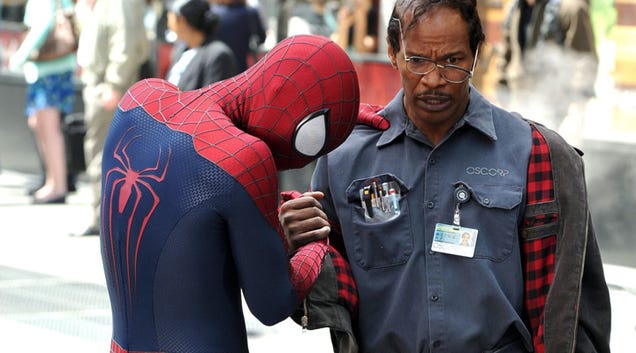
Oh. You're a geeky loner who is mentally unstable? Couldn't tell..

Another problem with The Amazing Spider-man 2 is in its oversimplified villains. Where Raimi actually did much to get us to sympathize to some extent with the villains, Webb gives us a simple, "I'll get you and your little dog to!" type villain. Jamie Foxx and Dane DeHaan do what they can with their one dimensional characters (DeHaan is actually surprisingly good in his role, even though it comes out of nowhere and only serves to force the shocking moment at the end of the film), but their motivation for going after Spider-man is razor thin, if not outright nonsensical.

Foxx plays cartoonishly nerdy scientist Max Dillon (who works at Oscorps because, you know, everything is connected now). Max is unrealistically and stereotypically dorky, almost something you'd expect to see on some teen-oriented sitcom in the '90s. His first appearance has him rushing around New York City carrying too many blueprints. His hair is parted in an awkward way and he has a giant gap in his front teeth. He also wears enough pens in his pocket to supply an entire bank. When Spider-man saves him, he reads his name tag to which Max freaks out thinking they're now friends because Spider-man knows his name! The frustrating thing here is that with enough time to focus on Max, we could have had an interesting and vaguely realistic or relatable development occur. There might be some message here about how we should not "pick on nerds" (or that you should be wary of nerds, because they're crazy!) However, it's hard to take it seriously when the movie doesn't. Through and through, they try far too hard to make Max unreasonably geeky. It's even complete with a scene in which BJ Novak shows up and makes fun of him for no real reason.

After his accident, there is another missed opportunity to develop the character in an interesting way. He stumbles through New York, full blown Electro at this point. He's confused and scared. When he accidentally destroys some stuff, NYPD shows up (in record time) and they all aim at him. Frightened even more, Max pleads for mercy. "It's not my fault!" he says. It's not entirely true, of course, but we understand that he isn't trying to hurt anyone. He has no idea what's going on either! It might still be his fault, but his intentions are not malicious at this point. When he looks up at all of the television monitors, he sees footage of him from all the television cameras. Max then has a moment where he's suddenly excited that people now see him and notice him. (This might have been a powerful moment if he had any vaguely realistic characterization in the first place.)

Enter Spider-man who forgot Max's name. This, of course, enrages him. Things go from bad to worse when the news cameras stop focusing on Max and instead focus on Spidey. And that's all Max needs to go from cartoonish crazy to full blown villain crazy. After he's captured and interrogated, he threatens his captors by saying he will show them what it's like to live in his world. It's a world without power. It's a world without being seen. These are powerful sentiments! But he doesn't stop there. "A world without Spider-man," he says. Max has every reason to hate the world, but the thing he latches onto the most is Spider-man? One of two people to show him any kindness in the entire film? What? It's such a forced moment that one almost expects him to follow that up by saying, "I'll get you, my pretty!"

Harry Osborn fares a little better, but not by much. His sudden appearance in the film creates a new plot thread in a movie already well stocked on plot threads. We see Harry and Peter reconnect (even though we never really saw them be super buddies in the first place, really), but this only serves to set up the melodramatic conflict between them not more than fifteen minutes later! DeHaan is a much better villain than James "No Face" Franco, but it doesn't change the fact that the character and that story is packed in there. He too takes an immediate grudge against Spider-man, although his makes a tad more sense than Electro's, given that he believes he needs Spidey-blood to save himself from the genetic disease turning him into a goblin. (And, ya know, in his defense, Spider-man could have maybe done a li'l more to actually explain why it was dangerous. Maybe he could have promised to run some tests and keep him posted? Harry would have still been pissed, but maybe if he saw that Spider-man was going to actively try to help him in some capacity?) There's also the theme introduced that Spider-man gives people hope, of which Harry rightfully calls bull on. I mean, Spider-man didn't even try to help him. It was all just this vague, "I'm trying to protect you" argument that the hero kept making without any more detail or explanation. Spider-man essentially just makes a "trust me" argument, and that never goes down well with anyone!
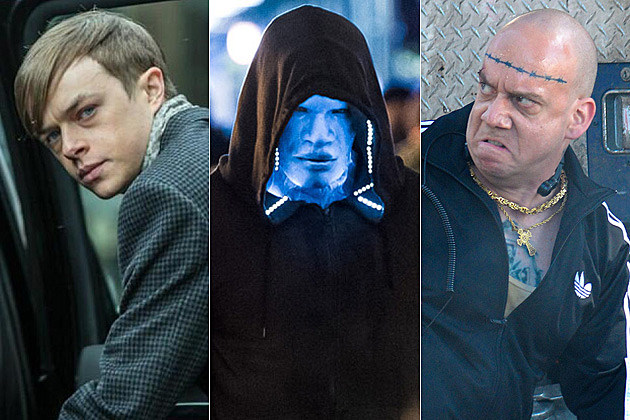
Three villains? Yeah! That's worked well before in the past! Fortunately, Rhino just bookend the film. 

Of course, the entire function of this bogged down, drawn out film is to kill off Gwen Stacey and introduce some more tragedy in Peter's life. The death of Gwen was a critical moment in the life of Peter Parker, but it also happens so early on. Here, we've seen a good amount of Spider-man action that it kind of doesn't make sense that he wouldn't have thought about the whiplash from yanking the web. He had enough experience and had shown enough intelligence that it feels forced - like everything else in the film.

The Spider-man suit looks a lot more traditional. Visually, it's the closest to the comics we've seen on screen. It's nice, and it probably appeals to most fans, but I actually kind of liked the redesigned suit in the first film. Electro looks like a character from Star Wars at first, then like an X-Men cast off. The Amazing Spider-man series falls into the same situation as Raimi's films in which the human elements were kind of bland, but they make up for it with awesome Spider-man action. Here is no different. Him zipping through the city looks awesome. The only missteps are the overabundance of Matrix-inspired shots that are unnecessary (and help drag out the film). In many ways, the action looks like a high end video game. One might expect to see a triangle or a circle show up on screen because it appears as if you were watching a quick time event in a video game.

Overall, the film serves as little more than a precursor to both The Amazing Spider-man 3 and its spin-off The Sinister Six. At this point, it just feels like we are sacrificing decent stories and films for the sake of "building to the next one." It works for comic books to an extent, but that's because those come out relatively quickly, and they're short to begin with. It works a bit less effectively for film. At this point, there won't be much of a point to ever really re-watch these first couple of Amazing Spider-man movies once they finish the story. You can't just watch these individually. More and more, they're building these films like long television shows. The least they could do is have it be no more than two hours.


To say that there were no good things about the film would be slightly inaccurate though. It's easy to be negative about this film - it isn't very good - but one of the coolest aspects of it was the score. Hans Zimmer and the Magnificent Six (which features Pharrell Williams and The Smith/Modest Mouse man Johnny Marr) conduct an intriguing score comprised of traditional film score elements, heavy electronica, and even some dubstep. Some of the tracks have lyrics that drop into the scene extremely well. As Electro is first facing off against Spider-man and quickly devolving into an even deeper madness, the score gets to a point where the lyrics include things like, "They laugh at me. They lie to me. They betray me. They ignore me." The lyrics reflect what Electro had been feeling. There was a moment where I couldn't tell if that was internal monologue! It works surprisingly well.

If there's one good thing I can say about The Amazing Spider-man 2, it would definitely be that the score is really interesting and is utilized in a really unique fashion.

But then really, that's pretty much the height of things it does well. That, and Spider-man is funny. Otherwise, the film plays out exactly how you think it will. It's an extremely predictable film - a fate that most of these films suffer, actually. The only "shocking" and "surprising" moment might be the end with Gwen Stacey's death, but if you're familiar with the comics, then even that is extremely predictable.
Let's be honest. This film is really just a commercial for the Sinister Six. 


Friday, April 25, 2014

TELEVISION! Scrubs (2001-2010)


Back when I was in high school, one of the shows to watch was "Scrubs." Before Zach Braff became the subject of hipster ire, he was the indie heart-throb. Both charming and introspective, he had the acting chops to pull off the comedic and serious elements of his role. The thing is, most actors on the show were as well. That is a large part of what made the show great for a long time.

The show is centered around Braff's character John "JD" Dorian, a young intern who works his way to becoming a great doctor, ruining relationships, and trying to fix them. The strange thing about JD is that as a protagonist, he is both very compelling and entirely annoying. Self-absorbed, he's also likeable. It does get frustrating, especially later in the show, how frequently his redeeming moments come after he was a giant jerk, but at least he did figure it out, right?

In many ways, he is a lot like his tough-love mentor, Dr. Perry Cox (the always enjoyable John C. McGinley).  Dr. Cox is every bit as self-absorbed as JD is, but he's less secretive about it. He openly berates his interns, is almost always hostile towards his friends and loved ones, and rarely shows affection. At the same time though, he is watching over these young doctors. He usually does the right thing, but he won't pat anyone on the back.

All of the characters are really like that. Carla is a prideful nurse who evidently gets insulted fairly easily by her superiors just because they claim to know better than she does. Elliot Reid is also easily thrown off, borderline psychotic when thinking of what others think of her. Turk is the hotshot surgeon who thinks he's the best at pretty much everything. Jordan is somehow even more hostile towards people as her husband (Dr. Cox). And the Janitor is literally in his own little world. Every one of the main characters is flawed and has elements that are totally unlikeable. And yet, they are likeable and do have redeeming qualities. In this way, they are surprisingly realistic, despite their goofy names and borderline caricature behaviors.

The strength of "Scrubs" is in how all of these disturbed and messed up individuals cultivate and grow their relationships, beginning as co-workers and eventually growing into a close-knit family. As the show progresses, they eventually work on some of their flaws through the typical aging process. Turk and Carla get married and start a family. Elliot comes into her own in a private practice. Even JD has to grow up as he watches his brother become successful, his father pass away, his friends marry and have kids. He even winds up with a child of his own! It's not just the young people growing up either. Dr. Cox has a family of his own and must struggle to find the balance between the tough-love act he has with his interns and being a relatively supportive father to his own kid. All the way at the top, Chief of Medicine Dr. Bob Kelso eventually has to deal with his forced retirement at the age of 65.

Like all great shows, there is a solid cast of background players as well. Ted is easily one of the most painful and hilarious characters on the show. Similarly, The Todd is every bit as funny as he is stupid. And there's also Doug, the intern who keeps screwing everything up to the point where he works in the morgue due to his ability to determine a patient's cause of death (since he has likely caused it at some point). Frankly, the Janitor and JD could have been its own thing, perhaps as little webisodes, as it was always entertaining to watch and seemed to happen outside of everything else.

It's easy to think of the show as one that jumped the shark after a few seasons. Most shows do (sorry, but "The Office" jumped after season four - how they pulled out another four seasons is beyond me). Indeed, the show does become less entertaining as time goes by. Come season six, you start to get a little bit tired of Turk and JD's immature antics. By season seven, you kind of just want JD to grow up. After all, he's been talking about it for a bunch of episodes already! Still, to say nothing interesting happens in later seasons isn't quite right. It's true, seasons one through three, as well as season five are clearly the best of the bunch, but the final season of Scrubs isn't all that bad itself. Apart from the general fatigue of some of these JD antics, they do some interesting things with Elliot. Additionally, the way that JD and Elliot reconnect after Sam is born is surprisingly organic. You see it coming, but you don't really sit there waiting for the moment, the way you used to wait for their typical moments in earlier seasons. Come the final season of "real Scrubs," you realize they aren't having one of those "moments." They're now older and more mature (in some respects), and as such, they are finally ready to actually form a relationship.

Note that I specific "Real Scrubs" because the actual final season of the show is so strange and different that it's only recognizable by the fact that McGinley and Donald Faison are regularly in it, with Braff making a few appearances. It's not necessarily bad, but it's profoundly less compelling with none of the supporting cast to make up for the main character deficiencies.

"Scrubs" is also a show that shouldn't age well, but it actually does. The format of having JD narrate can be a little tedious at times, and normally I don't much care for narration, but at times, they do use it well. They sometimes are a bit innovative with it as well. And it's always nice to see the occasional episodes where JD takes a back seat to another character. Additionally, a lot of the comedy is silly and almost Family Guy-esque with its use of cut-away fantasy sequences. Those get old, but they never feel quite as random or as stupid as in the aforementioned cartoon show.

The balance between comedy and serious content makes it both a funny and poignant show, with life lessons thrown into each episode. A lot of the jokes can be memorable, but more often than not you wind up remembering the sad ones. (For me, I always remember the episode when Brendan Fraser guest stars and has leukemia, or the one where Dr. Cox is ecstatic to find organs for a number of different patients, only to realize too late that those organs came from a patient infected with rabies.) These moments are usually made more powerful with effective use of music. "Scrubs" - at the same time as the classic "Orange County" - really popularized a lot of those indie acts, but that's also a staple of Braff fare.

I must admit, I didn't remember "Scrubs" being all that great when I went to rewatch it. I'm glad I did though. I do think seasons four, six, and seven are fairly forgettable, the one, two, three, five, and eight are surprisingly good. They definitely stand up better than other Bill Lawrence shows, and it didn't jump the shark nearly as hard. To be fair here though, Lawrence was essentially forced to keep dragging the show out for the final couple of seasons. He had intended to end it earlier, but faced pressure from the networks, especially after it uncharacteristically swapped from NBC to ABC.


Friday, April 11, 2014

MOVIES! The Hitchhiker's Guide to the Galaxy (2005)


It's been a long time since I've seen the 2005 adaptation of the Douglas Adams book. My initial memory of the film was that it was generally enjoyable, but otherwise somewhat forgettable.  What's nice is that Douglas Adams did have something of a role in writing the screenplay though he died several years before production. Though there are a good number of story and plot elements that were not in the book, the tone and sense of humor are fairly consistent.

The film starts with a goofy musical number sung by all of the dolphins in the world. "Thanks for all the Fish" is a good way to begin the film and set the tone. This is going to be a goofy British sci-fi comedy. It generally follows the same story of the book: Ford Prefect rescues his Earth friend Arthur Dent just before the planet is destroyed to make way for an intergalactic bypass (similar to how Arthur's house was unceremoniously destroyed for a bypass). They then find themselves aboard the Heart of Gold spaceship, a state of the art ship powered by an improbability drive, stolen by galactic president Zaphod Beeblebrox. Zaphod and his Earth-fling Trillian. Together with Marvin the depressed robot, Ford, Zaphod, Arthur, and Trillian search for the super computer Deep Thought, which once upon a time was constructed to find the answer for Life, the Universe, and Everything in it. The answer, as is well known, was "42," which annoyed and frustrated everyone in the universe. Another super computer was built to figure out the ultimate question to the ultimate answer. Turns out that Earth was that super computer.

The visual style of the film is a much appreciated change of pace from the typical sci-fi films. Instead of relying so heavily on computer graphics, they utilizes rubber suits and actors inside them. With Henson's Creature Shop, the film has a visual look not unlike The Fifth Element which further solidifies it's humorous tone. There is, of course, a good amount CGI as well, particularly when Slartibartfast shows Arthur around the rebuilt Earth. It's visually refreshing to see so much "analogue" effects.


Overall, the film isn't all that funny. There are the classic moments from the book, such as the sperm whale randomly being conjured up in the sky, and some of the entries in the Hitchhiker's Guide itself. It's not a hilarious film, but it has its laughs. The scene on the Vogons' homeworld in which a sentient flyswatter slaps them if they get any ideas is silly and simple, but is effectively very funny.

The draw to the film is in the cast. For a film that often gets ignored or forgotten, it has one of the best casts one can imagine. Martin Freeman is the perfect Arthur Dent while Mos Def is awesome as Ford Prefect. (Mos Def is clearly the best actor/rapper out there.)  Adding to it is Sam Rockwell, who is brilliant in the role of galactic president Zaphod Beeblebrox, seemingly mixing the swagger of both Elvis Presley and at the time president George W. Bush. Alan Rickman is perfectly cast as the voice of Marvin the constantly depressed robot, whose body language is well performed by Warwick Davis despite a huge and bulky suit. The weak link of the main cast might be TV sweetheart Zooey Deschanel, who is a bit underwhelming though still solid as Trillian. It doesn't just stop there though. Helen Mirren gives voice to the super computer Deep Thought. Bill Nighy shows up at the end as Slartibartfast. John Malkovich has a memorable scene as former president Humma Kavula. For more keen nerds, the voice of Bill Bailey appears briefly, voicing the internal monologue of the doomed whale. Thomas Lennon (of "Reno 911" fame) also appears as the voice of the Heart of Gold's computer, cheerfully and amusingly announcing things like oncoming missiles. And then of course, in another perfectly cast role, Stephen Fry gives voice to the actual Hitchhiker's Guide to the Galaxy, which is often accompanied by visually interesting animations. (And to the really keen observer, Edgar Wright and Jason Schwartzman can be found briefly.)


It's not a perfect film, and it fails to capture some of the charm from the book, but it's still largely similar. There's no real reason if one likes the book, one would dislike the film adaptation. Perhaps you might not like the way they dealt with Zaphod's two heads (it's a lot different than I imagined, and different than how the BBC series depicted it), and certainly the unresolved plot lines linger at the end. It does finish feeling like a sequel is in order. Still, it was a lot better than I remembered it being, and I actually feel a little bit bad that I always forget about it. Perhaps it's not worth going out and buying, but it's worth a replay every once in a while.


Tuesday, April 1, 2014

MOVIES! Ponyo (2008)


Everyone has their favorite Hayao Miyazaki film. Often it's Princess Mononoke or Spirited Away. People particularly nostalgic will often go with My Neighbor Totoro. One of his films though tends to be generally regarded as particularly "meh" and is almost never on anyone's list of favorites. That movie is Ponyo, Miyazaki's colorful and whimsically loose take on The Little Mermaid. 

By no means is Ponyo a bad film, of course. Even the weakest Miyazaki film is a strong film overall. Still, one of the possible reasons it generally gets ignored is that it's targeting a notably younger audience. The story follows five year old Sosuke as he befriends a strange goldfish with a human head who he promptly names Ponyo. The two fast become best friends. Meanwhile, Ponyo's father is trying to keep her from going to land. He is keeper of many magical elixirs and uses them to help protect the oceans, which are heavily polluted by the land-dwellers.

The movie is a story about five year old children and it's aimed at pretty much that demographic. The relationships are relatively simple, with Ponyo and Sosuke being pure and loyal to each other (as only children can be). The film does take a number of usual Miyazaki cues though. For starters, even though Fujimoto seems like the "villain" of the film, he's not really a pure villain. Yes, he harbors a grudge against humanity for polluting the seas, but he's ultimately trying to look after Ponyo. Though many are very simple, there are complex relationships throughout though. Lisa is often angry at her husband Koichi, who is a merchant sailor and often out at sea. This leaves Lisa mostly caring for Sosuke alone.

Ponyo is full of magic and is another strong female character, even if she does happen to be a bit simplistic. She's supremely entertaining. 

Late in Miyazaki's career, he started to delve more into the strange, colorful, and magical worlds. Of course, he's always had a penchant for that stuff (lest we forget the catbus), but it was in smaller doses. From Princess Mononoke to How's Moving Castle, he began taking full advantage of animation. Ponyo is very much the epitome of this style. Everything in the film could only exist in an animated film. Never mind all of the time spent underwater; there's also all of the creatures, the Mother of the Sea, the wave monsters, and all of Ponyo's magic. It is perhaps Miyazaki's most "animated" film of all.

For all of its whimsical and epic visuals, it's essentially more in the same vein as My Neighbor Totoro. Miyazaki himself even stated that he wanted to make something else kind of like Totoro, but for a younger audience. Ponyo is a bit simpler in themes as a result, but retains the strong female characters and complexities that make a typical Miyazaki film great. At times though, it's a bit more intense than Totoro. 

Ponyo takes a bit of flack sometimes from older audiences for being too simple or not compelling enough, but I'm not sure what really makes it different than things like Kiki's Delivery Service. It's not his best film, but it's still a great film. It's probably middle of the pack. Overall, I'd argue it's better than Castle in the Sky and possibly Howl's Moving Castle. But really, it's every bit on the level of all of his other works. It's just targeting a younger audience.

That, and our overly nostalgic generation really loves to hate new things.


Thursday, March 6, 2014

MUSIC! "Hanna" - the age of rockets (2008)


The Age of Rockets are a small name indie band that I fortuitously stumbled upon in a search for something else several years ago. More accurately, I was looking for something entirely different and they opened. (It was an mc chris show. The Age of Rockets don't really have much musical similarity with the nerdcore rapper who hates being called nerdcore even though that's exactly what he is, but one of their songs, "Elephant & Castle" gets sampled on mc chris's "Reese." Still, it wound up being one of the best openers I've seen outside of the Starlight Mints. EDIT: Just learned that Age of Rockets band leader Andrew Futral produced a few mc chris albums, which is probably why he was picked to open for the funny-voiced rapper.)

Hannah is their second album and shows a rather advanced sound for a small time band with little else striking beforehand. With an orchestral, synth-based sound, it's not hard to draw comparisons to the Postal Service. "Fearsome Though We Are," with its heavy synthesizer and it's chill drum machine mix well with singer Andrew Futral's quiet, breathy vocals to sound like a slowed Postal Service song. The comparisons are surface level only though. The song is immediately followed by "1001 Dirty Tricks to Kill Your  King," which loses most of the signature synth sounds or drum machines and focuses more on the orchestral side of things, instead featuring prominent violins, cellos, and soothing harmonies.

The album is also less pop-based like a Postal Service album tends to be. Of the eleven tracks, only one or two are even really "head bobbing." The aforementioned "Elephant & Castle" has a driving drum line and heavy synthesizer presence, but feels more like a slow-dance song while "Ship to Shore" is the only truly toe-tapping tune, and even then it takes time to build into it, quickly shedding that pop sound before building once more for the finale. The same holds true of the nerdily titled "Avada Kedavre," which slowly builds to the prettiest song on the album, with its quiet, subdued synths and topsy-turvey contradictory lyrics before erupting into the closest thing to a "dance song" on the album.

Futral tends to play around with song structure, staying away from typical musical patterns, instead playing with crescendos and diminuendos, giving new life to each different song. In many ways, Hannah winds up with a very cinematic feel to it.  The album is also very nicely wrapped up with "Stitches to Show Something's Missing," a song that is very similar to the first track, "What Story Down There Awaits Its End?" Musically, it takes on a similar life to the first track. By the end of the song, lyrics are lifted from other songs in the album, giving it a connection to the overall work and a nice sense of closure, culminating in an almost exhausting build up to the finale. (It's almost M83-like.)

It's an ambitious and unique album in an indie world increasingly dancy with its use of synths, making it a welcome change of pace. Hannah is one of the rare gems I've uncovered in my years of attending shows and suffering through unpleasant opening acts.


Monday, March 3, 2014

COMICS! World War Hulk (2007)


One of the more annoying elements about the DC and Marvel universes is their incessant need to have a "summer event," usually that shakes up the foundation of their world. Whether it's Marvel's constant shifting of the paradigm with their events like Civil War or Secret Invasion, or DC retconning, well, everything with Flashpoint, it's not hard to feel a little fatigue with such events.

This is what makes World War Hulk a notch above those aforementioned events! Sure, it doesn't try to shatter the status quo in the way those other titles did. And no, it's not as substantive as those books either. However, World War Hulk stands apart by being pure entertainment. It's fun. It's big without being earth-shattering. More importantly, it does it with a shorter, more direct story (it's just five issues long, so it doesn't drag the way that most other events do). And, if it did have a tie-in with one of your monthly books, it was only a brief distraction from the regular story! Marvel's previous events had a nasty habit of infecting your favorite series. Secret Invasion was the only thing being talked about in any book for the entire year, and Civil War had several issues get delayed which would then mean your monthly books got delayed so as to not spoil the main series.

World War Hulk doesn't need as much backstory as Civil War or Secret Invasion, nor do you need to be aware of much Hulk history like with a lot of X-Men events. Yes, you probably should have read Planet Hulk, but not so much because it enhances the story here; it's more because it's really just a great comic! Any backstory you need to know is presented pretty well throughout the five issues of the main title. There's also a solid "Prologue" issue that lets you in too, if the main series is somehow confusing.

All you really need to know though is that a group of Marvel's smartest heroes used to get together to problem solve the world's biggest troubles in secret. This list included Iron Man, Dr. Strange, Black Bolt of the Inhumans, Reed Richards, and often included Namor and Professor X (apparently, Black Panther doesn't cut it for these guys...) Several years prior, they gathered together (sans Charles Xavier) to figure out the "Hulk problem." Perhaps they had just watched the original Gamera, but they planned on tricking Hulk into a space ship, then blasting him off world. The plan was to shoot him to a peaceful planet where he could live his life in peace.

Only Namor objected (because Namor is awesome) and the plan was executed. There was just one small problem: the rocket ship didn't make it to the intended planet. Instead, it wound up on a brutal planet called Sakaar. Hulk was weakened from the travel and captured by the rulers of the planet. With an obedience disc attached, he was forced to become a gladiator and fight for sport. Eventually, he lead a rebellion and overthrew the oppressive rulers. With popular support, Hulk himself was named king of Sakaar. He took a wife and together they were destined to finally have a peaceful life. That is, until the rocket ship blew up, killing everyone including Hulk's pregnant wife.

That's how we get to the start of World War Hulk. Hulk is fast traveling on a rock-like space ship with his Warbound - his gladiator friends. He has never been more angry and thus, never more powerful. He even attacks one of his Warbound in blind rage, unable to see the alien attackers or his companions. Instead, he only sees Reed Richards, Tony Stark, Black Bolt, and Dr. Strange - the Illuminati who he's sworn vengeance against. It's clear the Hulk is coming to smash like never before.


Starting on the dark side of the moon, he faces off against Black Bolt. This is one of the few missteps of the book. Black Bolt is often regarded as one of the most powerful characters in the Marvel universe. Indeed, they reference this when the Hulk broadcasts a message to the world that they have twenty-four hours to evacuate Manhattan and give up Stark, Richards, and Strange. He concludes the message by holding up Black Bolt's battered body, unclear if he is unconscious or dead. Someone asks, "Who was that?" This, of course, merits Spider-man's response, "Until today, I would have said he's the second most powerful person!"

For all of the epic showdowns in the book, we are really only teased with the Black Bolt/Hulk fight. It happens quickly and takes place mostly outside the pages of the book. We Black Bolt unleash a whisper, which knocks Hulk back. Through the dust, Hulk's imposing figure appears and we know that the fight is about to get heavy. Before we can see it though, we cut away from the moon and show more on Earth. Next thing we know, Black Bolt has lost and we missed the fight. It's a little unfortunate given the high caliber fights we do see. Why do we see more of a less interesting Iron Man vs. Hulk fight when we could have gotten a better, more intriguing Black Bolt vs. Hulk fight?

That's pretty much all you need to know about it though. Each issue features a new Hulk vs. fight. We start off with Hulk showing up and beating Black Bolt, then messaging the entire world. In the second issue, we see him face off against Iron Man in his fairly useless Hulkbuster armor, then against Thunderbolt Ross and his military strikes. Neither of these enemies have a chance of defeating Hulk. Frankly, they'd be lucky to beat just one of his Warbound, each about as strong as the Hulk used to be.

While Hulk's Warbound faces off against the Avengers, the Hulk is busy turning Manhattan into a gladiator arena. His plan is to install obedience discs on all of these heroes and make them fight in the arena like he was forced to. Meanwhile, he's gaining support from many of the regular people. In one scene, a woman calls out Black Bolt for her husband's death during an Inhuman invasion of Washington DC a few years earlier. Then, a relative of Bill Foster calls out Tony Stark for Bill's death during the Civil War. One thing Marvel has always done differently (and better) than DC is showing the heroes in a different light. Some people might appreciate Spider-man, for example, but many will find him a menace. Or how much do you suppose someone would really like the Fantastic Four if their villains kept showing up in New York City to destroy things? There's always collateral to these events, and yet, the heroes never seem to have to face consequences of their mistakes.

Playing out through these issues is the build up to one of the greatest fights in any event: Hulk vs. Dr. Strange. Strange has tendency of being underutilized, but they pull out all the stops here. First, he tries to lure the Bruce Banner persona out through a spell that basically transports them somewhere else. Through conversation, Strange calms Hulk down a bit, trying desperately to convince him that the heroes were not responsible for the bomb in the ship. We think Strange is pulling the strings here, but it turns out that Hulk is really the one in charge. Tricking Strange to take a more corporeal form, he transforms back to his Hulk persona and crushes Strange's hands. This basically renders Strange useless as he can no longer perform gestures for spells. Still, he has one last trick: unleashing the demon Zom. So then a Zom-possessed Strange takes on Hulk and his Warbound, but he starts to lose control of the demon and needs Hulk to stop him. It's a role reversal, and it's one of the better fights.


Of course, nothing can stop Hulk except one of the most poorly treated (yet most interesting) characters: Sentry. The agoraphobic, schizophrenic superhero with the power of a million exploding suns is held on the sidelines for a while. Apart from being the most powerful superhero in the world, he can also lose control and become The Void - the most powerful supervillain in the world. As such, the other heroes like to keep him out of the game. They have no choice here though, with Stark urging him on by saying, "It's time to play god."

Sentry shows up like we've never seen before. He seems to relish the fight. It's the first time he can truly unleash his powers. The interesting thing about the Sentry though is that he was one of Hulk's few friends. It's possible he might have been able to calm Hulk down a bit to the point where conversation could mean something. Instead, thanks to Stark's "play god" comment, Sentry is itching for this fight. The sentiment shows the inherent flaw in the Illumanit's logic with every decision they've made. A group of five people was making decisions that affected the rest of the world and people they knew and loved, but they didn't consult anyone first. They themselves were "playing god" and it was constantly coming back to bite them.

The fight between the Sentry and the Hulk is epic. It lasts most of the final issue and makes it a quick read as a result. The two expend so much energy fighting on this whole other level that both of them slowly revert back to their human forms. It seems like the fight is over until one of Hulk's Warbound tries to stab Bruce in an effort to enrage the beast again and draw Hulk out. Hulk's old buddy Rick Jones steps in the way and is killed instead, which turns out is just as effective a method to get the Hulk out. We then find out that the Warbound knew it wasn't Earth's heroes who planted the bomb that killed Hulk's wife.

The fights are epic here. In this way, it's one of the more visual comic events to happen in years. Though it does have some depth to it, it ultimately functions as a "Hulk vs." event, which is incredibly fun. It's also a bit nice to see some of these heroes finally have to answer for some of their decisions (Iron Man and Reed Richards in particular have a tendency of being let off the hook).

There were a few tie-ins worth checking out as well. Ghost Rider's book (written by Deadpool regular Daniel Way) takes a reprieve from his demon-hunting to face the Hulk. The fight between Hulk and Ghost Rider is surprisingly awesome, but unless you read Ghost Rider regularly, the ramifications are a bit lost. (It turns out that Ghost Rider could potentially defeat Hulk in a fight, but the Spirit of Vengeance doesn't harm innocent people and is also controlled by its human host. The decision to face the Hulk is that of Johnny Blaze. By the end, Blaze no longer seems present and the full power of the Spirit of Vengeance is unleashed upon the world.)


Additionally, there is a pretty fun X-Men miniseries (written by the awesome Christos Gage) where the Hulk fights pretty much every X-Men member in an effort to take Professor X. Even though Xavier wasn't there when the Illuminati decided to launch Hulk into space, Hulk demands to know how he would have voted and punish him accordingly. Xavier admits he would have voted with the others and surrenders peaceably. However, his students refuse and engage in an awesome, three-issue battle with the Hulk. It ultimately comes down to a speech. When Hulk rages on about how he will not stop until they have suffered like he has, a young mutant steps in to reveal just how much the mutant population has already suffered. In many ways, they've suffered worse than Hulk.

Hulk is often presented as the wronged party here, but he also has his moments of unreasonable behavior that makes you think Stark and the others might have been right. Of course, they never intended to launch Hulk to a violent planet, but as they say, "The best laid plans of mice and men often go awry." In some ways, this story is more "grey" than Civil War, which went a little too far to paint the pro-registration side as "villains" even though they had completely legitimate arguments.

Short, epic, and hugely entertaining, World War Hulk is one of the better events from the last decade. It's worth checking out, and because it's not very wordy (it's mostly panels filled with action), it's also a quick read. Writer Greg Pak might be one of the best writers in comics today, knowing exactly what it takes to make a comic book fun. The art is done by John Romita Jr, which is solid, but it seems like you either love it or hate it. (I'm kind of indifferent to JRJR's art.)

You just better be ready for some smashing, because there's a ton of it!

Thursday, February 27, 2014

MUSIC! "Ukranian Pajama Party" - gideon freudmann


If you don't know Gideon Freudmann, you should.  A cross-genre cellist, odds are he's got many tracks or albums that will perk your interest. Self-described as "cellobop," he meanders many different genres of music, mostly on the cello alone, albeit an electric cello - not that you can tell the difference.

Ukranian Pajama Party is such an album (although it isn't just his cello). The album itself has such a variety to it that if you don't like one track, you can skip to the next and find something you do like.  It starts off a relaxing, poppy track that utilizes a mixture of bowing and strumming on the cello. It's accompanied as well by a delightful steel drumming. "Brannock Device" starts the album off making it clear that this is going to have a little bit of everything.

A couple of tracks later, we get to the titular "Ukranian Pajama Party," similarly mixing the bowing and strumming techniques. It's a lazy tune accompanied by some electric guitar. It sounds shades of Western and feels like you need to be reclining with your hat tilted low over your eyes.

Freudmann is at his best with his instrumentals. Still, he is something of a funnyman and will occasionally sing over his music. "Japanese Car" and "Stole a Pony" are examples of that. The former is a quick paced song that almost sounds like he's just making it up as he goes, simply listing types of cars. The songs with lyrics tend to be the weakest (although "Japanese Car" has an excellent instrumental component). But it's nice to see his goofy sense of humor shine through.

A few more tracks in and you reach "Camel Sutra," a song inspired by the sounds of the Middle East. Solely comprised of whimsical bowing, it's only enhanced more by the hand drumming. We return to the jazzy sounds of "Melodious Thunk." As the name implies, it draws its inspiration from jazz pianist Thelonious Monk. Freudmann plays the cello more as an upright bass to accompany the Monk-like piano piece. Some steel drum is thrown in for good measure.

"Everytime" breaks out several tracks later with more of a rock 'n' roll sound, with a heavier electric guitar. Lyrically, it breaks from the typical silliness of his vocal songs. "Bugsondrugs" calls back a similar sound to the start of the album with a faster paced, bowing and strumming jam before ending on "Natasha's Galoshes," another song that transports you to lazy summer afternoons chilling on the back porch.

Freudmann's incorporation of different musical styles doesn't always come across as obviously as Ukranian Pajama Party. It maybe lacks an especially memorable track the way that his other albums often do. There is no "Robin Hood Changes His Oil" here. Overall though, the album is one of his better and perhaps most fully represents him as a musician. If you're one of those who feels the cello is an underutilized instrument in music (which it is), you should pick up pretty much any Gideon Freudmann album.


*The above clip is of "Robin Hood Changes His Oil," one of my favorites. It's not on Ukranian Pajama Party, but he's a smaller name musician and not a lot of his stuff is on YouTube. This gives you a great idea of what you can expect from any given Gideon Freudmann album though!